

Background
I have spent years talking to organizations running legacy systems, and one pattern repeats almost everywhere I go. The technology question is rarely the hard part. The hard part is that nobody can fully explain how the system actually works anymore. The people who built it are retiring. The ones who maintain it learned by watching. The documentation, if it exists, describes how things were supposed to work, not how they do. That is the problem MYRA was built to solve.
Where this hits home
You have probably seen at least one of these:
A senior employee retires and nobody fully understands a critical operational process they owned. A modernization budget gets approved before anyone has actually mapped the business rules. Onboarding a new engineer takes months because the procedures exist only in tribal knowledge. An audit request exposes operational gaps the leadership team did not know were there. The business runs on systems nobody wants to touch. Leadership cannot confidently answer the question: how does this really work?
These are not edge cases.
They are the default condition of most enterprises running mature systems. And until they are addressed, modernization is an act of faith.
Why traditional modernization fails
Most large modernization efforts fail in the same way. The organization decides to replace or enhance a system before it fully understands how the current one operates. Business rules are buried inside procedural logic. Documentation is incomplete. Critical operational behaviors are only discovered after deployment, often when something breaks.
The result is predictable. Budgets overrun, timelines slip, and the new system ships missing the very rules the old one was built around.
The MYRA approach
MYRA establishes a structured understanding of the enterprise before any decision about replacement is made.
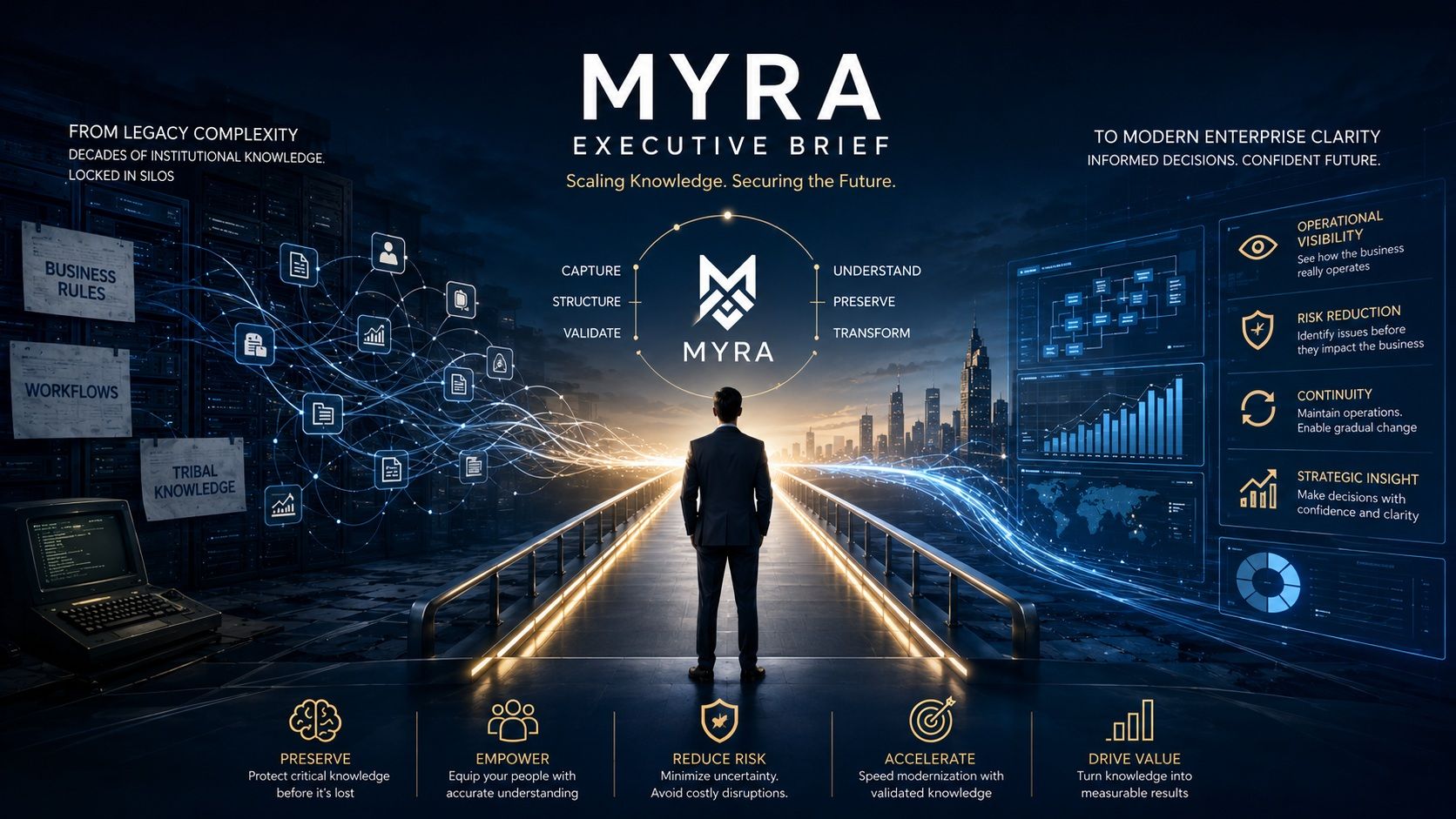
By analyzing applications, workflows, user interactions, and operational behavior, MYRA produces an intermediate knowledge model that exposes business rules, process dependencies, and system relationships in a form that can be reviewed, validated, and governed.
This shifts modernization from assumption-driven activity to informed decision making.
In practical terms, this changes what is possible.
Preserving institutional knowledge
MYRA chronicles how systems are actually used in production, capturing the workflows, decisions, and operational logic that have historically lived only in the heads of a few experienced people. The result is a durable institutional asset that survives turnover, retirement, and reorganization.
Transferring it to the next generation
Traditional knowledge transfer relies on interviews, shadowing, and manual documentation. It is inconsistent, expensive, and rarely complete.
MYRA captures operational behavior directly from real-world system usage, preserving workflows, decision paths, and process rationale in a structured and repeatable form.
The knowledge becomes scalable, queryable, and reusable long after the original experts have moved on.
Onboarding staff faster
Training new personnel on complex enterprise systems is slow because documentation is fragmented and procedures depend on a small number of experienced employees.
MYRA provides a validated operational reference that lets new staff understand how systems are actually used, not just how they were intended to operate. Ramp-up time drops. Procedural consistency improves. Dependence on tribal knowledge fades.
Reducing risk
MYRA enables organizations to validate workflows, compare expected against actual behavior, and identify operational dependencies before changes are made. Measurable understanding of existing operations is the single largest factor in reducing modernization risk.
Continuity over disruption
Modernization can proceed at a pace aligned with business priorities rather than technical urgency. MYRA is designed to work alongside existing enterprise systems without forcing their replacement. Continuity of service is preserved while transformation moves forward.
What this means for executives
Most executives are surprised to discover how much operational complexity exists below the level of their visibility.
MYRA makes that complexity visible, often for the first time. It creates a foundation for modernization planning, succession readiness, audit, compliance, and long-term strategic decisions.
The result is a more resilient organization, more confident transformation, and a leadership team that can finally answer the question every board eventually asks: do we actually understand what we own?
Conclusion
Knowledge is the future
Enterprise modernization is no longer constrained by technology. The constraint is operational knowledge. The companies that thrive in the next decade will be the ones that treat that knowledge as the strategic asset it has always quietly been.
Next Step
The first step is not replacement. It is visibility.
Organizations that build operational understanding now will enter modernization with lower risk, greater confidence, and something most enterprises lack entirely: a clear picture of what they actually have.
That is what MYRA delivers.
To learn more
🗓️ Schedule an executive briefing
a focused MYRA Discovery engagement creates a practical foundation for informed modernization decisions. We would welcome the conversation.