

A Strategic Guide for C-Level Executives and Board Members
Abstract
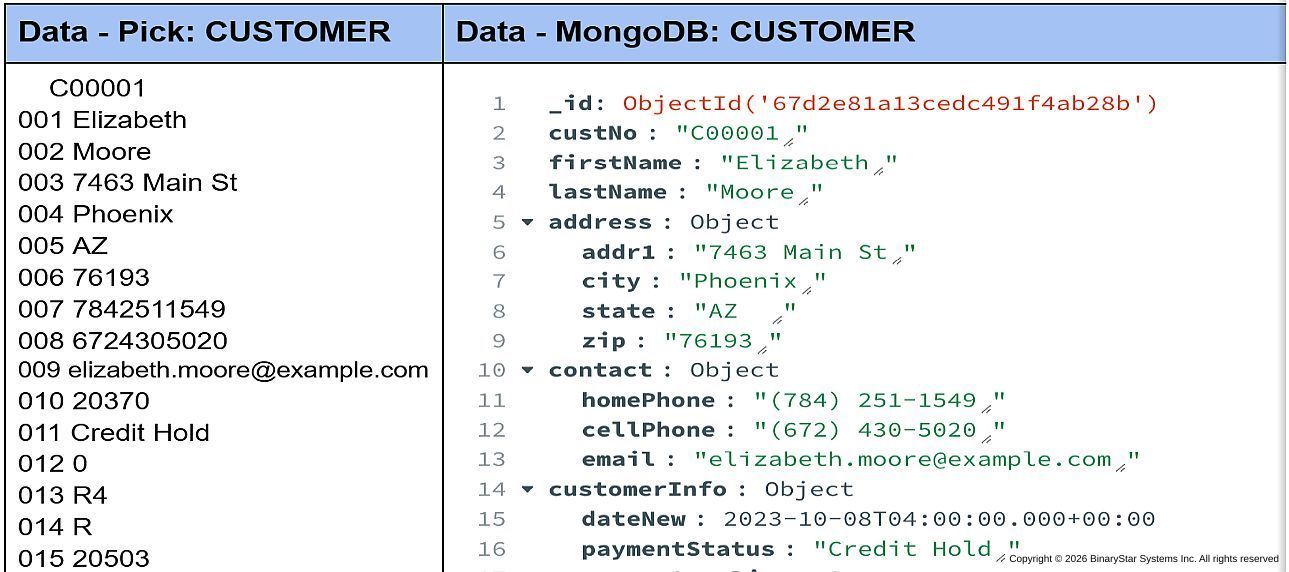
After decades of reliable service, legacy PICK applications have finally given up their monopoly on your mission-critical data. The migration to MongoDB opens new strategic horizons — from analytics and API-driven integration to modernization and AI enablement. But what happens next is not just a technical decision; it’s a business strategy that defines competitiveness, agility, and enterprise value.
This article outlines practical, board-level options once your PICK data resides in MongoDB — and how to transform that milestone into measurable business advantage.
1. The Data Has Moved — The Business Must Follow
Migrating PICK data into MongoDB is not the end of modernization; it’s the beginning of reuse and reinvention. In its new home, your data is now:
- Schema-flexible, enabling fast adaptation to new business needs.
- API-accessible, so it can feed modern apps, dashboards, and AI models.
- Cloud-ready, meaning scalability, security, and global accessibility are built in.
For the C-suite, this means the business is no longer captive to a terminal interface or a generation of soon-to-retire specialists. You now control your own evolution.
2. Strategic Option 1: Build an API Ecosystem
MongoDB data can be exposed through REST or GraphQL APIs, turning the database into a live, shareable business platform. Benefits include:
- Rapid app development — internal teams or partners can innovate without waiting for database rewrites.
- Integration with SaaS ecosystems — CRMs, ERP, BI tools, and mobile apps can plug in directly.
- Governance and control — APIs act as managed gateways, allowing security, logging, and performance tracking.
Strategic plan:
Adopt an API-First architecture
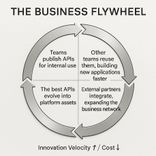
- Define which data domains (customers, orders, jobs, inventory) become “platform assets.”
- Start with a small number of high-value APIs, measure reuse, and expand systematically.
3. Strategic Option 2: Leverage Analytics and Insight
Legacy PICK data was notoriously hard to mine. Now, in MongoDB, you can connect to Power BI, Tableau, or Looker, or build real-time dashboards with React and Node.js. Executives gain visibility never before possible:
- Performance metrics across divisions and time horizons
- Profitability by customer, product, or region
- Predictive models for churn, credit, or maintenance
Strategic plan:
- Stand up a Data & Insights Workstream.
- Focus on quick wins: management dashboards, anomaly detection, or cost-to-serve analysis.
- Tie results to tangible KPIs — revenue per user, service time, error reduction.
4. Strategic Option 3: Modernize Applications Gradually
Instead of rewriting everything, modern teams can wrap existing logic in microservices and modern UI frameworks like React, Angular, or StarView. The business logic stays intact; the experience evolves.
- Replace green screens with responsive web apps
- Streamline workflows with modular, service-based components
- Introduce new capabilities — notifications, digital signatures, mobile access — without disturbing the core logic
Strategic plan: Use the “Hybrid Path” — build modern experiences on top of the legacy logic, then refactor module by module as ROI justifies it. This avoids disruption while delivering visible progress to users and stakeholders.
5. Strategic Option 4: AI and Automation
Once in MongoDB, data can fuel AI-driven processes:
- Natural-language query interfaces for staff and customers
- Automated classification and recommendation (e.g., matching jobs, parts, or service requests)
- Predictive forecasting for sales, inventory, and maintenance
- Data-driven migration tools that further modernize code and schema
Strategic plan: Create a Data Innovation Lab to pilot AI-enabled services. Use safe, bounded use cases first — e.g., smart search, claims routing, or parts prediction. Each successful pilot becomes a reusable building block in your modernization roadmap.
6. Strategic Option 5: Monetize Your Data
For organizations with extensive historical datasets, there may be new commercial opportunities:
- Offer anonymized industry benchmarks
- Enable supplier or partner APIs under subscription
- Support marketplace or affiliate integrations
- Derive insights that can be packaged into value-added services
Strategic plan:
- Conduct a Data Monetization Feasibility Study.
- Evaluate compliance and IP ownership early.
- If viable, assign a product owner and revenue target to at least one “data-as-a-service” initiative within 12 months.
7. Governance and Risk Considerations
Freedom comes with responsibility. MongoDB environments must still uphold:
- Access control and audit trails (via role-based authentication)
- Data lineage and retention policies
- Encryption at rest and in transit
- Regulatory compliance — HIPAA, GDPR, SOX, or industry equivalents
Board oversight should ensure governance scales with innovation.
8. The Roadmap: From Migration to Modernization
| Phase | Focus | Outcome |
|---|---|---|
| 0–6 months | API enablement, reporting access, quick wins | Visibility and early ROI |
| 6–12 months | UI modernization, hybrid workflows | User adoption and agility |
| 12–24 months | AI pilots, data products, ecosystem integrations | Strategic differentiation |
Each milestone compounds in value — turning data liberation into enterprise transformation.
Conclusion: The Real Value Lies Ahead
Moving PICK data to MongoDB was the first courageous step — a foundation, not a finish line. Your next moves will determine whether this transformation becomes a competitive edge or a technical curiosity.
The winners will:
- Treat data as a strategic asset, not just a storage format.
- Build API ecosystems that unlock reuse and speed.
- Empower teams to innovate safely through modular modernization.
- Use AI to augment decision-making and automation.
In short, the move to MongoDB has opened the door. What you do next defines your enterprise’s future.
Next Step:
🗓️ Schedule a discovery call
Talk about issues and opportunities for your current system before you commit.