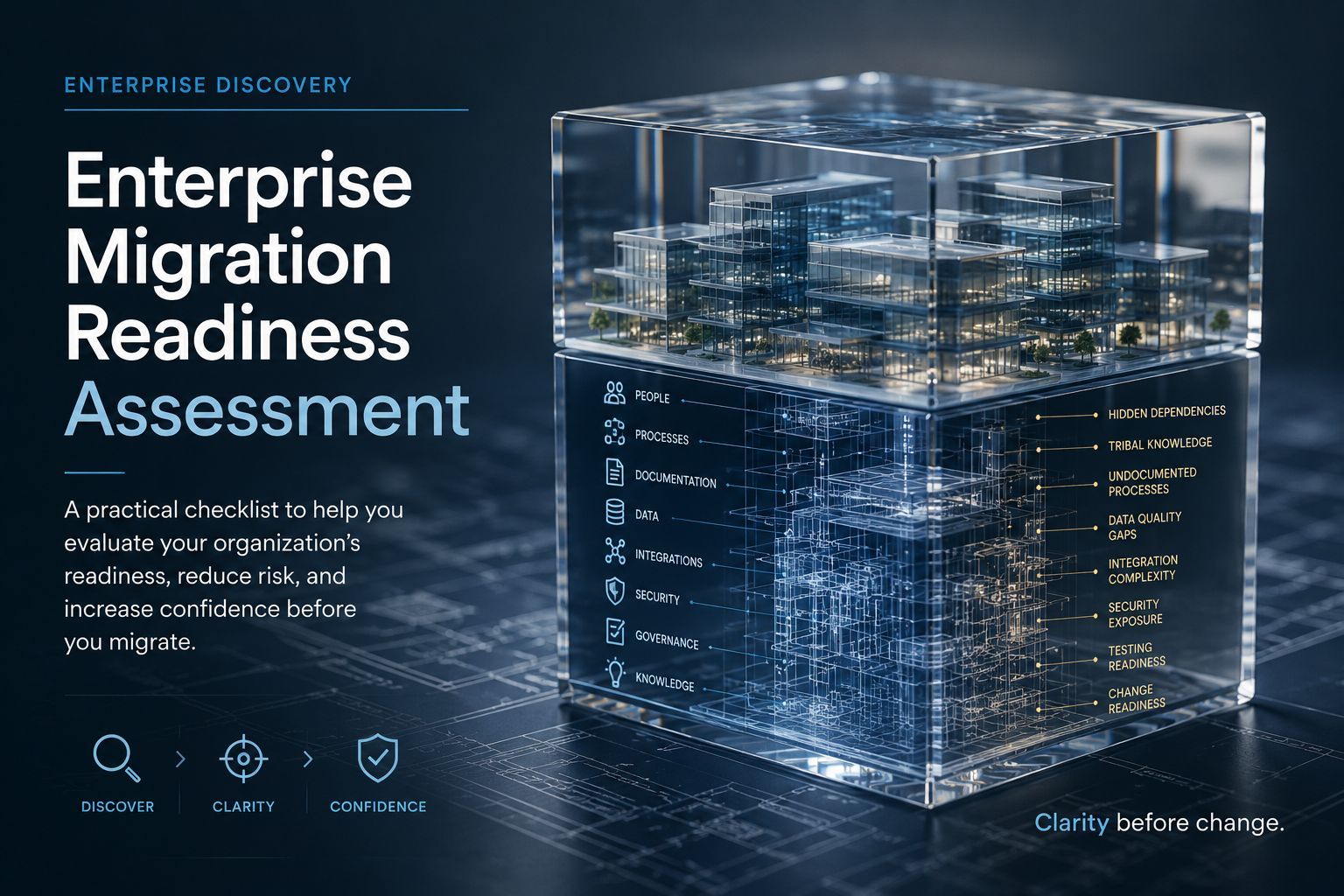


Enterprise Migration Readiness
Technology migrations are rarely limited by technology.
More often, they are delayed by incomplete knowledge, undocumented processes, hidden dependencies, conflicting assumptions, and critical expertise that exists only in the minds of a handful of experienced people.
The Enterprise Migration Readiness Checklist is designed to help organizations evaluate their current state before significant investments are made. It encourages meaningful conversations about operational readiness, knowledge continuity, documentation quality, data integrity, integration complexity, governance, testing, and organizational preparedness.
Completing the checklist is not about achieving a perfect score. It is about revealing where additional discovery can reduce uncertainty, improve planning, and increase confidence throughout the migration journey.
Whether your organization is planning a cloud migration, application modernization, platform replacement, acquisition integration, or AI initiative, a clear understanding of today's environment is the strongest foundation for tomorrow's success.
Take a few minutes to work through the checklist. The insights you gain may prove to be every bit as valuable as the migration itself.
Executive Readiness
□ Do we know which applications are truly mission critical?
□ Do we understand how they actually work?
□ Are undocumented processes hidden inside legacy code?
□ Could another team maintain these systems tomorrow?
Knowledge Risk
□ Is critical operational knowledge concentrated in only a few employees?
□ Are retirement or turnover risks understood?
□ Is knowledge being transferred before people leave?
□ Can management measure knowledge concentration?
Documentation
□ Is our documentation trusted?
□ Does documentation match reality?
□ Can new staff become productive using existing documentation?
□ Are undocumented workarounds common?
Technical Readiness
□ Do we know our external integrations?
□ Can we identify obsolete components?
□ Are dependencies documented?
□ Can changes be tested safely?
AI Readiness
□ Is our business logic understandable by AI?
□ Are UI and business rules separated?
□ Could AI explain why the application behaves as it does?
□ Can AI safely assist with modernization?
Governance
□ Can we estimate modernization effort?
□ Do we know which projects should happen first?
□ Can executives measure modernization progress?
□ Can we justify investment with measurable risk reduction?
Final Thoughts
Every successful migration begins with a clear understanding of the enterprise it is intended to improve.
Technology can be replaced. Infrastructure can be upgraded. Applications can be rewritten. What cannot be recreated easily is the operational knowledge accumulated over years—or decades—of serving customers, supporting employees, and adapting to changing business needs.
The Enterprise Migration Readiness Checklist is intended to help reveal that understanding before important decisions are made. It highlights areas where additional discovery can reduce uncertainty, uncover hidden dependencies, preserve critical knowledge, and improve confidence across the organization.
Migration should never be viewed as simply moving systems from one platform to another. It is an opportunity to gain a deeper understanding of how the business operates today and how it should operate tomorrow.
Organizations that invest in discovery before they invest in migration consistently make better decisions, manage risk more effectively, and create stronger foundations for long-term success.
If this checklist raises questions about your own environment, that's a positive outcome. The answers often begin with Enterprise Discovery—bringing together the people, processes, documentation, and systems that define how the business truly operates.
Clarity before change is one of the most valuable investments any organization can make.