


Abstract
For decades, software development began with the interface — what the user would see on a screen. Today, forward-looking organizations start somewhere else: the API.
“API First” isn’t a slogan for engineers; it’s a mindset reshaping how companies design products, integrate partners, and future-proof their operations. By putting Application Programming Interfaces at the center of strategy, enterprises build systems that are modular, scalable, and ready for whatever comes next — new markets, new technologies, or new business models.
From Monoliths to Modular Thinking
The traditional way to build software was linear: design the user experience, wire up the backend, then figure out how to connect it all. The result was often a brittle product — difficult to integrate, slow to update, and locked into specific technologies.
An API-First approach reverses that order.
It begins by defining how data and functionality will be exposed, shared, and reused — before a single screen is drawn. The API becomes the contract that all teams, partners, and applications agree upon.
That contract turns complexity into clarity. It ensures that as systems evolve — mobile, web, cloud, partner integrations — everything speaks the same language.
To the board, this is not a technical nuance. It’s architectural risk management: a way to prevent the next five years of growth from being strangled by the next five years of technical debt.
The API-First Flywheel
Once established, an API-First model creates a self-reinforcing loop:
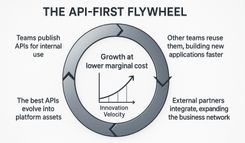
- Teams publish APIs for internal use.
- Other teams reuse them, building new applications faster.
- The best APIs evolve into platform assets.
- External partners integrate, expanding the business network.
Each iteration increases the velocity of innovation and decreases the friction of change.
In board terms: growth at lower marginal cost.
The Business Case for “API First”
The logic is deceptively simple: when you design your APIs before your applications, you’re designing for reuse, speed, and resilience.
- Reuse: Core capabilities — like authentication, pricing, or shipping — can be accessed anywhere without rebuilding them.
- Speed: Multiple teams can develop simultaneously against the same API specifications, accelerating time to market.
- Resilience: If a new platform, vendor, or regulation appears, you adjust the API layer instead of rewriting entire systems.
In a competitive landscape where speed is synonymous with survival, API-First thinking becomes an insurance policy against obsolescence.
Why This Matters to the Boardroom
Executives don’t need to know how APIs are coded, but they do need to understand what they make possible.
An API-First enterprise is designed for change. It can spin up new digital products faster, integrate acquisitions more smoothly, and participate in data ecosystems securely and confidently.
For M&A activity, APIs can slash integration costs and timelines. For compliance, APIs provide auditable and traceable flows of data. For innovation, APIs open controlled gateways to partners and startups without compromising security.
In essence, API-First is not about technology — it’s about optionality. It gives leadership the freedom to pivot without rewriting their past.
From Internal Systems to Ecosystems
The “API First” principle extends beyond internal development. It enables the ecosystem economy — where companies no longer compete in isolation but as platforms surrounded by collaborators.
Think of how Amazon, Salesforce, or Stripe grew: by making their capabilities accessible through APIs, they didn’t just sell services — they invited others to build on top of them.
That ecosystem effect compounds over time.
An API-First company becomes a platform company: not only efficient internally but also magnetic externally.
APIs as the New UX
In an API-First world, the first user isn’t a customer with a smartphone — it’s a developer.
When developers can easily discover, test, and trust your APIs, your organization becomes a destination for innovation. Well-documented APIs lower barriers to entry, shorten onboarding, and reduce dependence on scarce internal talent.
For the board, this means innovation at scale — the ability to grow through collaboration, not just headcount.
Governance and Security, Reimagined
An API-First approach doesn’t mean uncontrolled openness. On the contrary, it introduces predictable governance.
Every API can be versioned, monitored, and secured through a gateway. Access keys and throttling policies ensure compliance. Metrics track who’s using what, and why.
This turns the previously invisible tangle of integrations into a transparent, auditable infrastructure — a comfort to both CFOs and CISOs alike.
Cultural Transformation
“API First” is not just a design choice — it’s a cultural statement.
It signals that technology and business are partners, not silos.
Product managers can think in terms of capabilities rather than applications. Developers focus on services that outlast any single interface. Leadership can measure digital initiatives in terms of reuse and reach, not just project timelines.
This culture rewards collaboration, documentation, and repeatability — traits that scale far better than heroics and hand-offs.
The Economics of API-First
From a financial perspective, API-First development reduces waste.
Instead of building isolated solutions that are re-implemented across teams, enterprises invest once and reuse endlessly.
- Lower development cost per feature.
- Shorter delivery cycles.
- Reduced vendor lock-in.
- Increased asset value — APIs themselves become monetizable components.
In time, the organization develops a digital portfolio — a catalog of reusable, governed APIs that function as an internal marketplace of capabilities.
That library compounds in value like intellectual property — because that’s exactly what it is.
Avoiding the “Afterthought API” Trap
Many organizations still treat APIs as something added later — a connector, a convenience, a way to expose data once the main product is finished.
This approach is a recipe for fragility. APIs designed after the fact inherit every inconsistency of the underlying system. They break easily, scale poorly, and require constant maintenance.
By contrast, API-First forces discipline early. Teams design with clear boundaries, document intent, and align business semantics from day one. That rigor pays dividends for years.
It’s Never Too Late to Include APIs in Legacy Systems
Not every organization starts from a blank slate — and that’s okay.
In fact, some of the greatest returns on API investment come from wrapping legacy applications and exposing their capabilities securely to modern systems.
For decades, companies have accumulated valuable business logic inside ERP, CRM, and mainframe systems that are too expensive or risky to replace. APIs turn those systems into digital assets rather than liabilities.
A legacy billing system can provide real-time pricing data to a mobile app.
A manufacturing control system can feed production data to an analytics dashboard.
A government record system can provide secure citizen access through a web portal.
In short: It’s never too late to include APIs in connection to legacy apps. Doing so allows organizations to modernize incrementally, preserve stability, and measure progress without gambling on wholesale rewrites.
APIs act as bridges, not bulldozers — connecting past investments to future opportunities.
Why “API First” Is the Foundation of Modernization
Most enterprises sit atop decades of valuable data and business logic trapped inside legacy systems. API-First doesn’t require throwing those systems away — it wraps them in modern accessibility.
Instead of replacing your core, you extend it.
Instead of rewriting your history, you republish it as a service.
This approach aligns perfectly with the “evolution, not revolution” philosophy that boards prefer: incremental modernization with measurable ROI at each stage.
And for those who worry they’ve missed the API wave — they haven’t.
It’s never too late to connect, extend, and evolve.
Conclusion: The Strategic Imperative
“API First” is not a developer fad. It is the strategic architecture of the digital era.
It ensures that every new initiative — whether mobile, AI, analytics, or automation — plugs into a coherent foundation. It keeps the enterprise nimble without sacrificing governance.
To the C-suite, the message is clear:
API-First is how you build a company that can move fast and stay safe — a company whose digital future is not constrained by its digital past.
Because in modern business, agility isn’t coded at the end.
It’s designed from the start — and for those still running on legacy systems, it’s never too late to begin.
Next Step:
🗓️ Schedule a discovery call
Talk about issues and opportunities for your current system before you commit.