

Introduction
"In many Pick and U2 legacy environments, the most critical business logic is fused directly into user interface screens—creating operational fragility, modernization dead-ends, and strategic uncertainty for the boardroom."
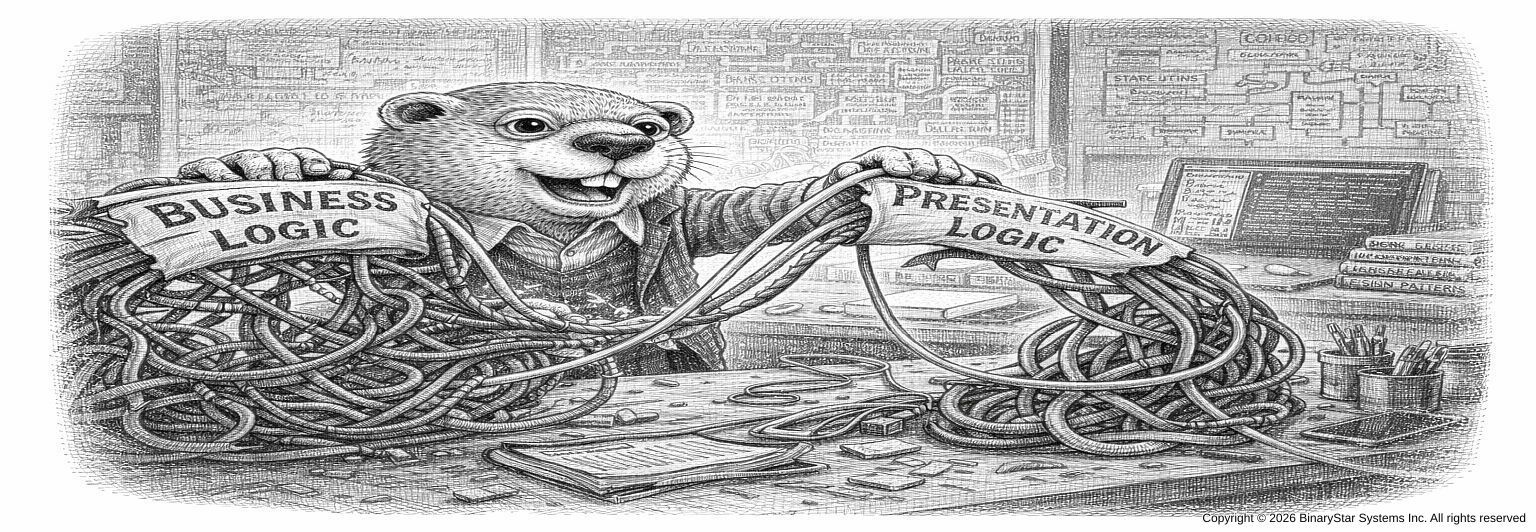
"In legacy Pick/U2 systems, the user interface is not just a window into the application—it is the application. This architectural fusion of logic, workflow, and presentation now threatens the ability of organizations to adapt, integrate, and comply."
The Commingled Logic/UI Problem in Legacy Systems
In a quiet office park in the Midwest, a manufacturing company that has been in business for more than five decades is facing a problem that no one can quite name. The production lines still run. Orders are still taken. Invoices still go out. On the surface, everything functions as it always has. But enter the IT department—past the framed "Last Write Wins" jokes and the huge 10-1/2" 9 track tape drive standing like a museum exhibit—and you’ll find a computer system whose defining feature is not age, but architecture. And it is that architecture that now threatens the company’s ability to adapt, grow, or even understand its own operations.

For enterprises running Pick, U2, or other Multivalue descendants, this architectural flaw is pervasive yet invisible. It is the commingling of logic and user interface—a tight fusion of presentation, workflow, and computation. What appears on the screen does not merely represent the application. It is the application.
This design once accelerated development. Today, it creates a modernization dead end.
Where the Screen Is the System
Modern software engineering rests on a shared foundation: business logic lives in one layer, user interfaces in another, data models in a third. This separation is what makes cloud deployments scalable, web and mobile apps maintainable, and development teams more than one person deep.

Pick and U2 systems predate these principles. In many of them, screen definitions—once rendered on green-on-black terminals—contain everything: input handling, calculations, branching logic, workflow orchestration, even security. Business rules are inseparably woven into the visual flow presented to the user.
The result is that pricing rules, eligibility calculations, compliance logic, penalties, credits, and routing decisions are embedded not in modular functions but inside UI templates.
“It’s like operating a factory where the conveyor belts, robots, and safety rails run on the same circuit,” said one CIO who inherited a Multivalue system from a retiring predecessor. “If you touch anything, everything else flickers.”
A Legacy of Ingenuity—Now a Liability
Pick's architecture—ingenious in the 1970s and 80s—emphasized speed and compactness. Developers compressed logic, storage, and presentation into a single structure that behaved almost organically.
Screens acted not just as interfaces but procedures. They asked questions, validated input, guided users through branching paths, and applied business rules in real time.

For years this approach was astonishingly effective.
It let small teams build deeply customized applications quickly.
But that same fusion now makes the system fragile.
When the interface is fused with the logic, the enterprise cannot evolve without rewriting the past.
The Inheritance Nobody Wants
Executives describe these systems with a conflicted mix of respect and dread. They appreciate the history; they fear the consequences of touching it.
At a distribution company, an attempt to modernize a single invoicing screen—expected to take two weeks—stretched to six months.
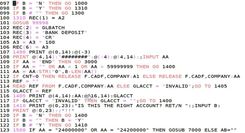
“Every time we changed a field,” the finance director recalled, “something else broke. Totals went wrong. Discounts vanished. And no one knew where the real logic lived because it wasn’t in a function. It was in the screen.”
To engineers, this is logic entanglement.
To executives, it is operational risk.
Why Commingled Logic Prevents Modernization
The consequences of UI-bound logic manifest across the entire enterprise:
1. No Modularization = No Modernization
- Logic cannot be containerized, refactored, or migrated when it is fused to the UI itself.
2. Automated Testing Becomes Impossible
- Testing a logic flow requires simulating a user. Tools cannot isolate the business rules.
3. APIs Cannot Be Built Reliably
- You cannot expose a UI-bound workflow as a modern API without recreating the entire journey.
4. Documentation Loses Its Meaning
- Documentation describes what a user sees—not how the system actually makes decisions.
5. Every Enhancement Is a Risk Event
- A simple UI tweak can cascade into unexpected logic changes elsewhere.
6. Knowledge Loss Is Catastrophic
- Only a shrinking population of legacy programmers knows how the layers interact. When they retire, the logic retires with them.
Why the Boardroom Should Care
The commingled logic/UI problem extends far beyond the server room. It affects:

- Innovation velocity
- Integration with partners
- Ability to comply with new regulations
- Accuracy of financial reporting
- Business continuity
Most critically, it traps institutional knowledge inside a system that cannot explain itself.
Executives in these organizations often encounter the same unsettling realization:
The company’s true intellectual property is locked inside code that no one fully understands anymore.
When User Interface Dictates Business Behavior
An unusual symptom of commingled logic is that user behavior influences business outcomes.
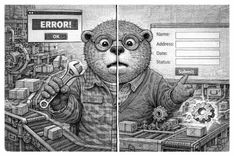
Because different UI paths trigger different embedded rules, two employees entering identical data can receive different results not by policy, but by interface.
A health services organization learned this during a state audit. Eligibility determinations varied entirely based on which UI path different caseworkers used. The system wasn’t merely recording decisions; it was making them.
The company froze all UI changes and assigned its oldest programmer to shadow auditors.
He retired six months later.
The Modernization Dead End
Organizations trapped in this architecture often attempt conventional modernization strategies:
- Screen scraping (too brittle)
- Rewrites (too expensive, too risky)
- Off-the-shelf system replacement (workflow mismatch)
- Manual logic extraction (labor-intensive and error-prone)
Nothing works easily because the problem is not technical debt—it is architectural debt.
The logic isn't in the system.
The logic is the screens.
The Moment of Reckoning
Executives often reach a breaking point when a seemingly small request—a tax rule update, a pricing change, a workflow adjustment—reveals the depth of entanglement.
What should take days takes weeks.
What should cost thousands costs hundreds of thousands.
What should be safe feels dangerous.
The conclusion becomes unavoidable:

The organization cannot evolve
until its core logic is separated from its user interfaces.
This is the heart of the modernization crisis in legacy Pick/U2 environments. Not the hardware. Not the retiring developers. Not the missing documentation.
But the architecture itself.
Next Step:
🗓️ Schedule a discovery call
Talk about issues and opportunities for your current system before you commit.
Coming Soon
Article 2: The Supportability Problem — When Fixing One Bug Breaks Three Departments
All subsequent problems in this series—supportability, stack fragility, development challenges, connectivity gaps, the aging guru crisis, and auditability—derive from this foundational issue.
If the logic cannot be disentangled from the interface, nothing else can be modernized safely.
It is the quiet, structural flaw that has shaped the last 40 years of legacy evolution.
And it may determine the next 10.